


Occasionally we have a conversation with a customer that is surprised by how much a commercial or industrial pressure washer costs, or they state the price is outside their budget. When we ask why they are surprised or how they established their budget, it is often stated that they saw a pressure washer with the same PSI rating and gallon flow online at a lower price.
But, there is an adage “you get what you pay for.” And often, a person is willing to pay more if they see or understand the value of a heavy-duty commercial pressure washer vs an entry level budget commercial pressure washer. Two machines can list identical PSI and GPM and still be worth very different prices — the numbers on the box are only the starting point of the comparison, not the end of it.
So how do you know that the commercial pressure washer price tag you’re looking at is worth it?
The Pump
Often when comparing pumps, PSI and GPM are the sole focus. While it’s true that these ratings are important to determine if the a particular pressure washer is right for your application, there’s a lot more beyond the specs that determine whether a pump can actually meet these figures consistently, and how quickly they’ll wear down from use.
In order to actually compare one pump to another, let’s dive a little deeper into the real differences between heavy commercial grade and budget pumps.
- RPM. Why does RPM matter? Lower RPM means less heat. The pump runs cooler, the oil lasts longer, and the seals undergo less wear. Heavy-duty, industrial grade pumps running at 1000-1450 RPM have a 5-10x longer life-span than budget 3400 RPM pumps running under the same load.
- Seal Temperature Rating. Heavy-Duty Commercial grade pump seals are often rated as high as 185°F, compared to temperature ratings as low as 100°F on budget pumps. A higher temperature rated seal allows for higher inlet water temperature. They also provide a level of protection against by-pass water temperature spikes as a result of prolonged periods a trigger is closed and the pump is circulating in by-pass mode.
- Crankcase Size. Heavy-duty commercial pressure washer pumps may hold 50% more oil than budget pumps. More oil means better lubrication, less heat and dramatically longer pump life. Larger crankcases typically pair with larger camshafts, connecting rods and bearings, distributing the load more evenly, reducing friction, stress, wear, heat.
- Manifold Wall Thickness. The manifold on a heavy-duty commercial pressure washer pump can be up to 46% thicker than the manifold on a budget commercial pressure washer. Thicker walls handle pressure spikes better, resist warping, cracking and erosion over years of use.
- Check Valve Cage. The cage of the check valve in many heavy-duty commercial pressure washer pumps can be 20% thicker than budget pump options. A thicker check valve cage resists deformation and failure under repeated pressure cycling over the life of the pump.
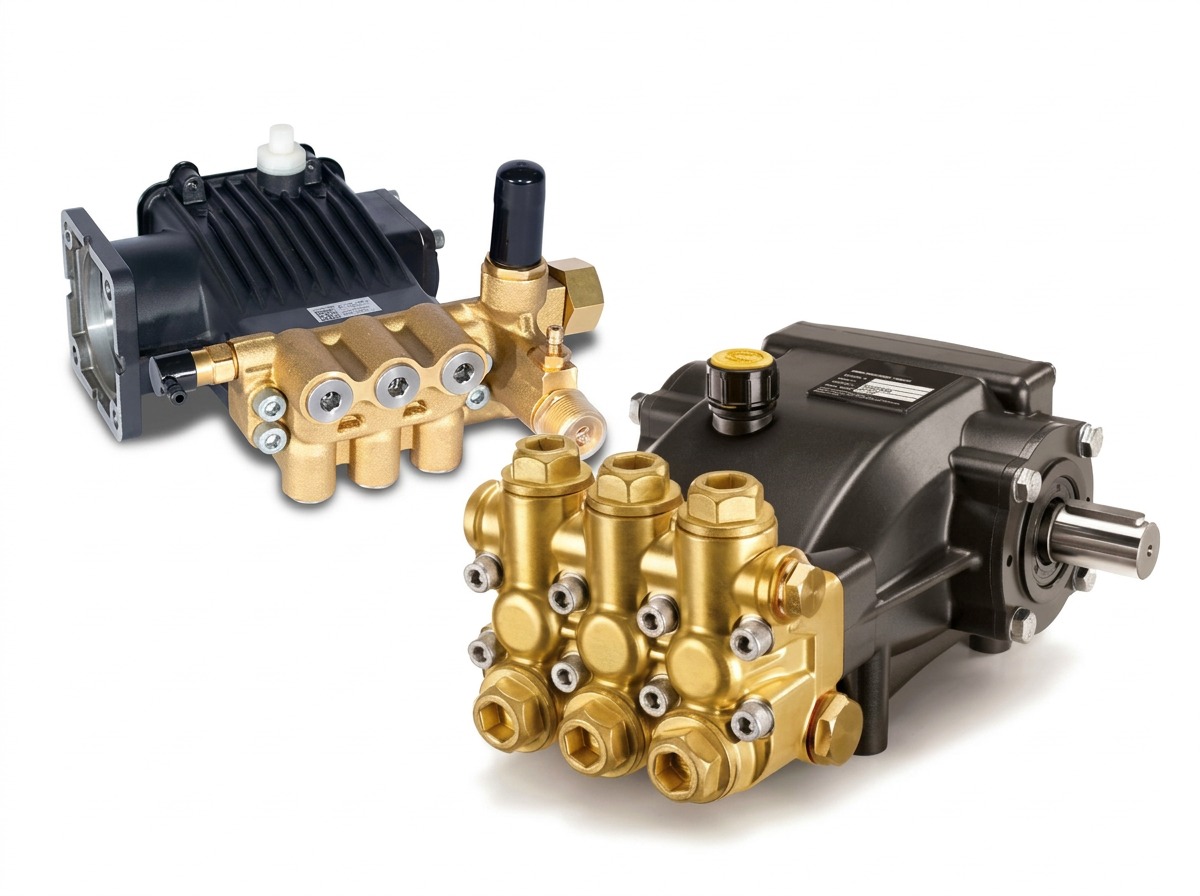
PSI and GPM listings don’t tell you any of this. Open a heavy duty commercial pump and a budget pump side by side and you’re looking at two completely different products wearing the same specs. They are built to two very different price points for a reason – and you get what you pay for. An industrial grade pump is designed to last for years, while a cheaper budget brand pump may last you a season or two before requiring pricey repairs or replacement.
Heating Coil Construction
A BTU rating and maximum temperature on a spec sheet only tells you the number. Often, the maximum temperature spec is the water temperature at which the burner will shut off — if the water ever reaches it. The spec that actually matters is temperature rise: the difference between the incoming water temperature and discharge water temperature. Two machines can list identical BTU output with a 210-degree max temp and still be built to very different standards. A budget built commercial pressure washer may never hit its maximum temperature spec. When comparing a heavy-duty commercial pressure washer to a budget pressure washer, here are a few points that drive the price difference.
- Wall Thickness. Coil wall thickness comes in three general tiers. Schedule 80 pipe, used in most heavy duty commercial pressure washers, is thick-walled and built to shrug off pressure spikes, thermal cycling, and hot spots for the long haul. Schedule 40 pipe is a lighter, faster-heating middle ground with reasonable durability. Thin-wall tubing heats fastest and is the cheapest to build but comes with the lowest durability of the three. Thicker wall buys longevity; thinner wall buys a lower price tag — sacrificing how long the coil holds up in the field.
- Coil Length. This is an area to check under the hood. To look like a heavy-duty commercial pressure washer, many budget commercial pressure washers pair a large combustion chamber with a short coil that may only fill 30% of it — less material, less labor, and a lower price, at a real cost to durability.
A longer coil spreads heat transfer across more surface area, giving the water more dwell time and contact with the heated coil to absorb heat before it exits. That means the machine holds its temperature without overworking the metal. A shorter coil hitting that same BTU number has to run hotter per foot to get there — concentrating heat flux, raising the coil’s skin temperature, and increasing the risk of scale-driven hot spots and premature burnout.
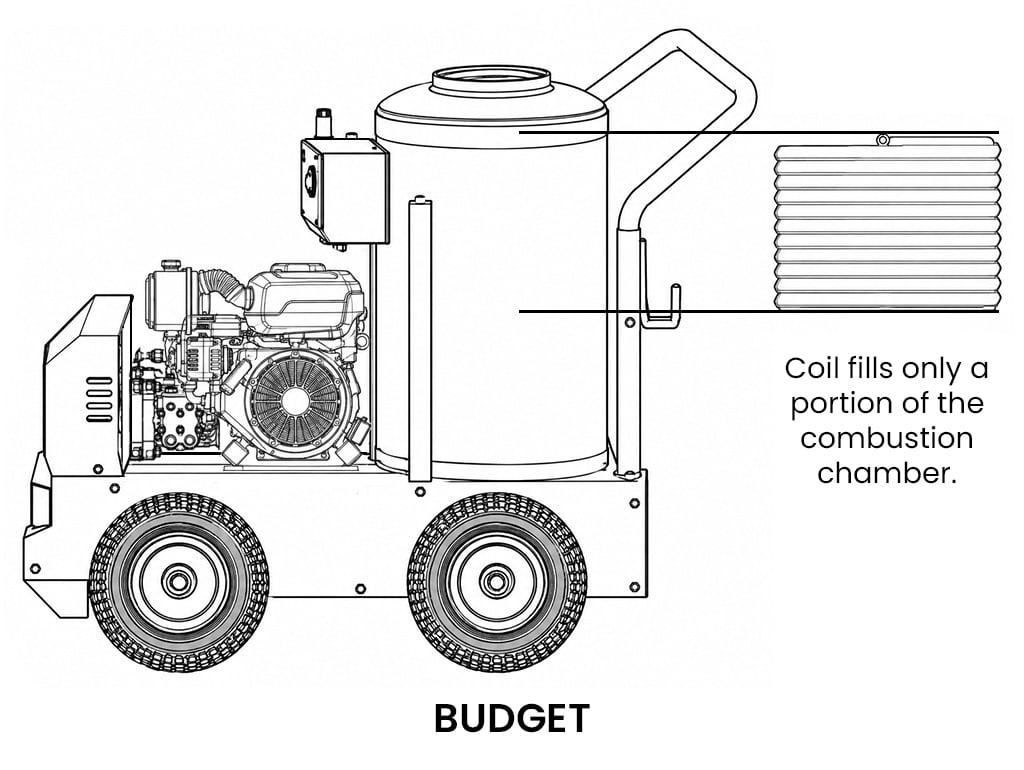
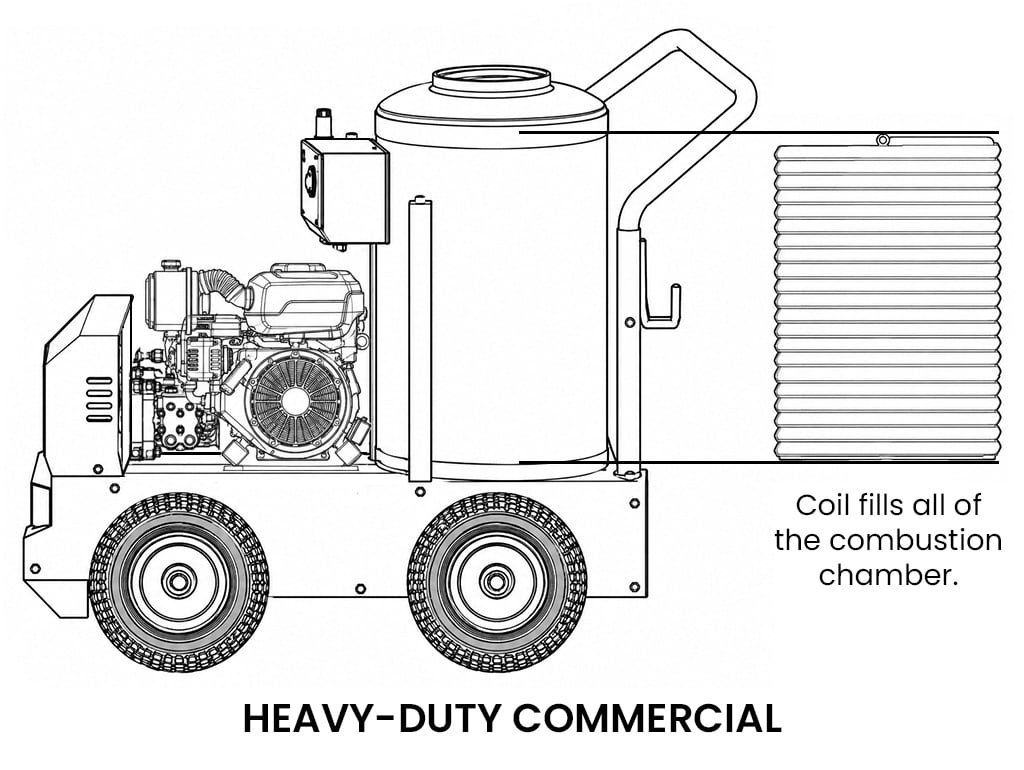
Coil wall thickness and coil length are a big part of why a heavy-duty commercial pressure washer costs more initially than a budget commercial pressure washer. They’re also a big part of why a heavy-duty commercial pressure washer has a lower cost of ownership over the life of the machine than a budget commercial pressure washer. Ask about the coil length and wall thickness, not just the maximum temperature listing on a spec sheet.
Warranty — Who Fixes It, Where & How Fast
The lower price of a budget commercial pressure washer often reflects a limited short-term warranty against manufacturing defects. There is no warranty for labor or transportation cost, and no extended warranty coverage for the most vital parts on the machine.
Another thing to consider is what happens when something does break, who’s going to fix it?
Many budget commercial pressure washer brands have limited knowledgeable parts and service support, nor do they have local service centers that can repair your equipment. Instead, they often require you to send your machine to a repair facility – at your expense.
| Budget Brands | Heavy-Duty Brands | |
|---|---|---|
| Pump Warranty | - | 7-Years |
| Coil Warranty | - | 5-Years |
| Labor Warranty | - | 1-Year |
| Parts Warranty | 1-2 Years* | 1-7 Years† |
On the other hand, most manufacturers of heavy-duty commercial pressure washers have factory-authorized dealers in cities throughout the US. Factory-authorized status means the dealer can perform warranty repairs in-house, using genuine parts, without shipping your machine off or waiting for remote approval.
Plus, the inventory maintained by your local authorized service center means the part your machine needs is often on the shelf — not backordered from a national distribution center.
It also means accountability you can walk into. When you buy online, “customer service” means waiting in a phone queue. When you buy local, it’s a person who answers the phone right away, or a shop you can drive to, who knows your equipment, your application, and your account. That’s the difference between a same-week fix and a month of downtime.
That support network costs money to build and maintain. When you don’t need it, it can feel like an unnecessary premium. But down time is expensive – when you do need the support, purchasing from a local commercial pressure washer dealer with a factory authorized service center earns its value back many times over.
Safety Certification
There’s no federal law that says a manufacturer can’t build or sell a pressure washer that is not safety certified. That means manufacturers are free to build to a lower bar for the consumer/homeowner market, and even in budget commercial pressure washer contexts.
However, OSHA states that employers must ensure that any equipment used is safe for its intended purpose and complies with the relevant OSHA standard. They mandate that any electric pressure washer used by an employee must be certified to UL 1776 by an OSHA-designated Nationally Recognized Testing Laboratory.
That’s an employer obligation, not a manufacturing ban — it just means an employer who buys an uncertified unit is the one out of compliance, not the manufacturer.
Safety certification testing isn’t free, nor are the upgraded parts that are required to pass. A manufacturer that skips it is passing that savings on to you at the register — while quietly passing the risk back onto you as the buyer.
Worker safety should be non-negotiable. Safety certification shifts liability protection onto the equipment itself. In an environment of costly litigation, one of the best legal protections against a workplace accident is purchasing equipment that’s been listed by a recognized testing lab — meaning if an operator is injured, “we bought certified equipment” is a real line of defense.
Uncertified equipment leaves that exposure entirely on the buyer.
The Bottom Line: Deal or No Deal?
A matching PSI and GPM rating doesn’t make two commercial pressure washers the same deal. The pump, the heating coil, the dealer network behind the machine, and the certification on the nameplate all carry cost — and all carry consequences down the line. A budget commercial machine can hold up fine under light or occasional use. But for a business running equipment daily, the lower price up front often gets paid back — with interest — in downtime, repairs, and risk.
Before you compare two commercial pressure washers on price, compare what’s actually inside them. Ask about pump construction, not just pump type. Ask about coil length and wall thickness, not just max temperature. Ask who services the machine, and how fast. And ask whether it’s certified — because in a workplace, that piece of paper is real liability protection, not red tape.
Spec sheets tell you what a machine is rated to do. They don’t tell you what it’s built to survive. That’s the difference heavy-duty commercial construction is priced for — and it’s what separates a deal from no deal.
Have questions about whether a heavy-duty commercial pressure washer is the right fit for your facility, or whether the price difference actually pencils out for how you’ll use it? The team at Northstar Clean Concepts can help you evaluate your application and your numbers.
* Generally a blanket limited warranty for all parts including pumps and coils.
† Generally a 1-year parts warranty and up to 7 years on chassis and frame parts.