

When commercial buyers shop for a pressure washer, PSI is usually the first number they ask us about. It’s the number on the label, it’s most prominent in pressure washer marketing, and it’s easy to compare across models. However, PSI is actually only half the story — and for a lot of operations, it’s not even the half that matters most.
GPM is the other spec that many commercial pressure washer buyers don’t always consider. It’s not as “sexy” to talk about and it’s sometimes hidden in the pressure washer spec sheets – but in the end, it honestly might just be the spec that matters more to your unique cleaning application.
So how do you know which spec wins when considering PSI vs. GPM? Or does your operation ultimately require a balance of both?
PSI vs. GPM: What Each Spec Measures
PSI (pounds per square inch) measures the force behind the water coming out of the nozzle. Higher PSI means more impact per square inch of spray.
GPM (gallons per minute) measures how much water moves through the machine. Higher GPM means more volume flowing out per minute.
Think of Them as a Team
PSI and GPM aren’t competing for the same job; they’re covering different ones. Picture PSI as a boxer throwing hard, precise jabs — that’s what breaks the dirt loose. GPM is the rinse, the sheer volume of water that carries everything away once it’s loosened. Neither one gets the job done well on its own.
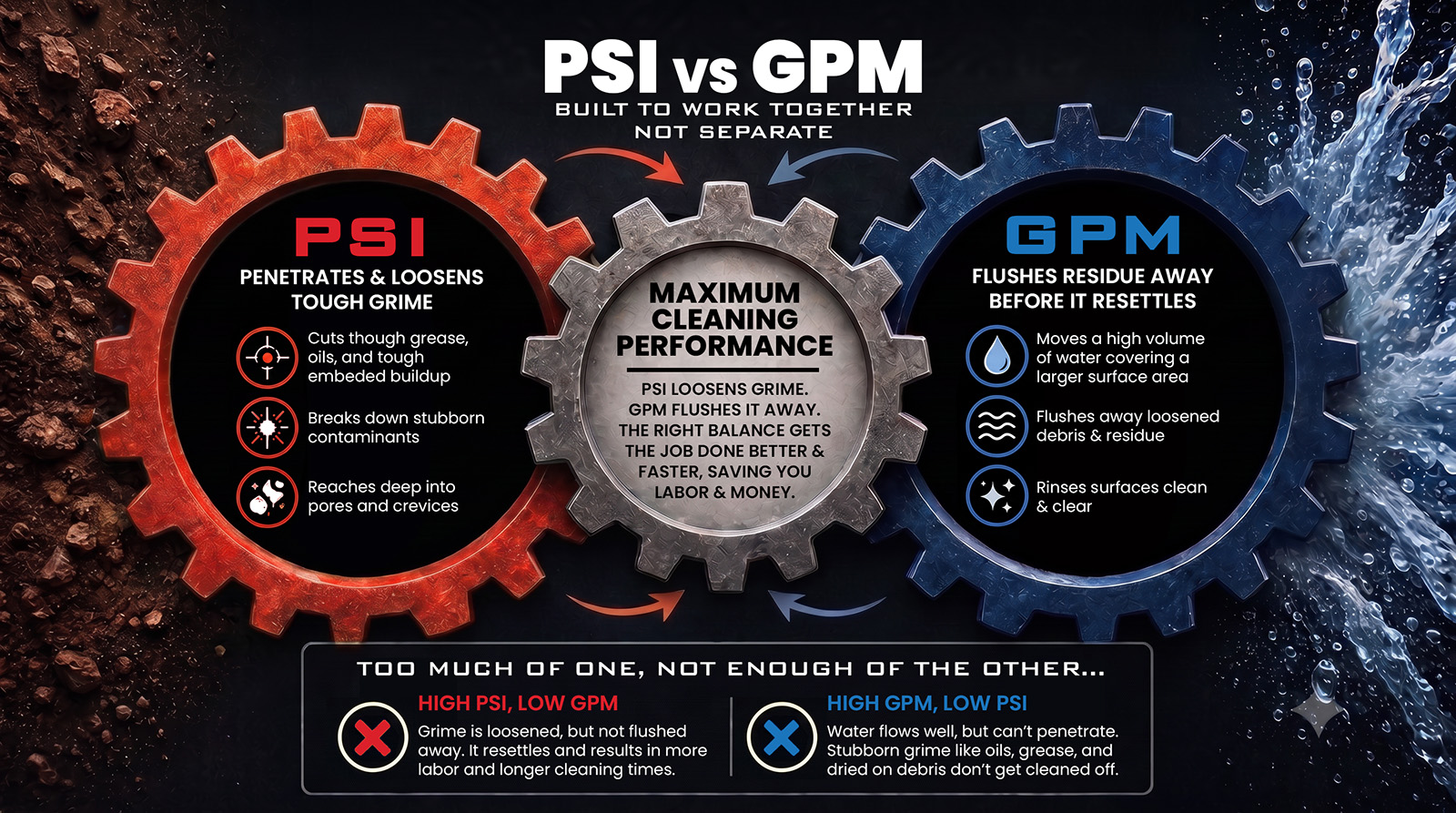
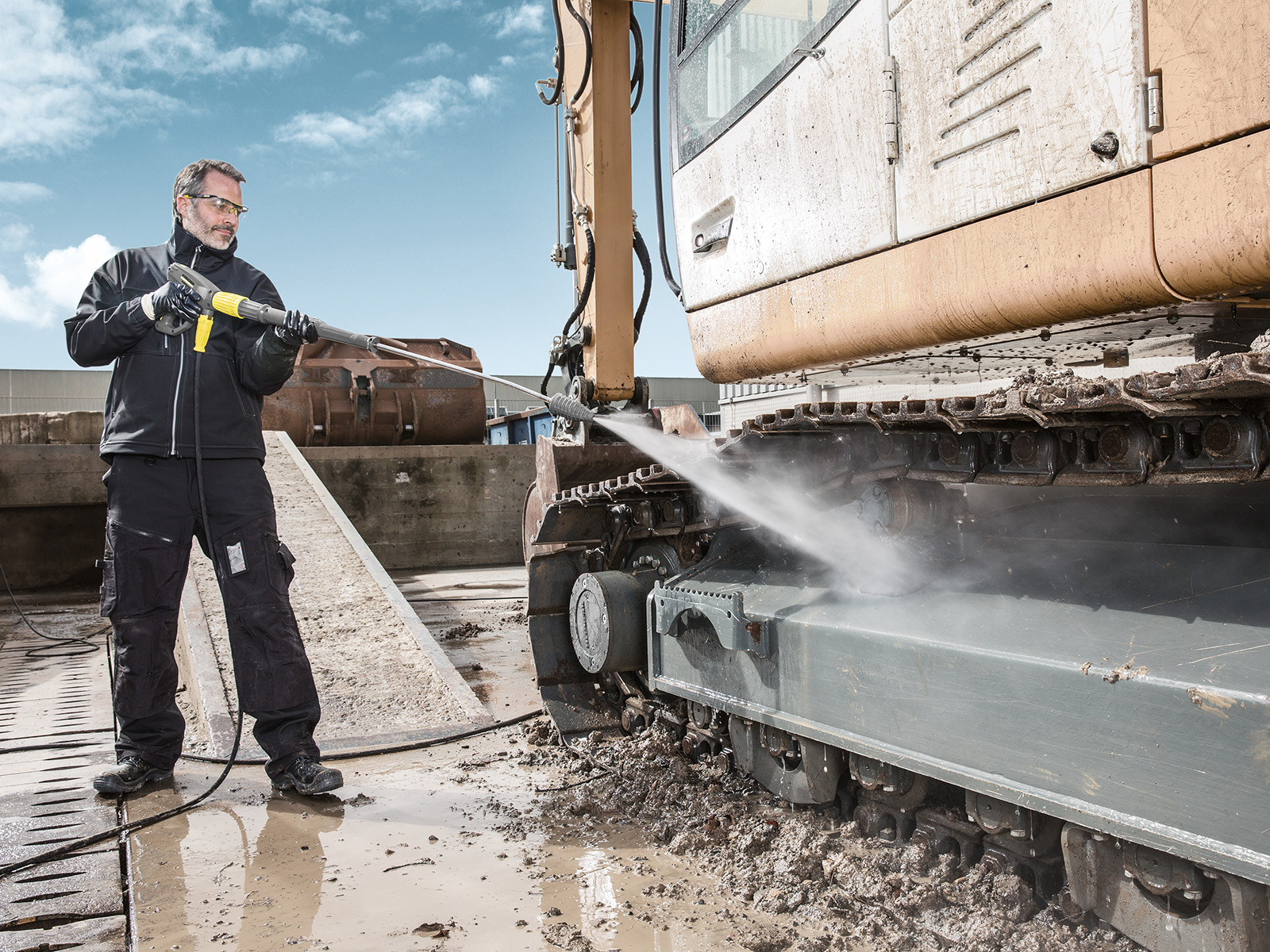
Here’s a scenario that makes this real: say you’re cleaning heavy equipment off a logging site — thick, embedded dirt and grease. You’ll need high PSI to break that grime free. But if your flow rate can’t keep up, you’re left fighting a losing battle — the dirt just breaks up and resettles somewhere else, and now you’re doing extra labor to chase it down.
Flip it around: crank the GPM way up with modest PSI, and you’ll rinse surface debris fast, but you won’t touch anything that’s really stuck on. The sweet spot is a machine that balances both, so you’re breaking dirt loose and clearing it away in the same pass.
PSI vs. GPM: What This Looks Like Across Common Jobs
Most cleaning tasks can technically be handled by a lower-flow or lower-pressure machine — you’ll just pay for it in labor time. So when you’re buying, it’s worth stretching your budget toward more power if you can. You can always dial a bigger machine down to match a gentler job, but you can’t dial a smaller machine up when the job calls for more than it has.
With that in mind, here’s roughly what different jobs tend to demand:
- Washing cars, trucks, or small equipment: Medium flow around 3.5 GPM, PSI starting around 2200
- General property maintenance and painting prep: Medium flow around 3.5 GPM, PSI starting around 3500
- Moss and algae removal from siding or roofs: Higher flow around 5.0 GPM or more, to thoroughly rinse the growth out roots and all, while going easy on the PSI so you don’t damage delicate surfaces
- Fleet or heavy equipment cleaning: High flow around 6.0 GPM and up, PSI starting around 3000
The Case for Higher GPM
A higher flow rate mostly comes down to speed — a 5.0 GPM unit is going to knock out a driveway noticeably faster than a 3.0 GPM one, which adds up fast in labor and time savings. It also tends to clean more thoroughly, since more water moving across a surface does a better job carrying dirt and grime away completely rather than leaving it to resettle. And because it handles a wider range of tasks well, a higher-GPM machine gives you more versatility if your work covers different surfaces and jobs.
The bottom line on flow: more water moving through the system means a stronger push against the dirt, which keeps it from settling back down before it’s fully rinsed away. Less redeposit means less scrubbing, which means less labor overall.
Why Those Higher-GPM Machines Cost More
Moving more water at higher pressure isn’t free from an engineering standpoint. It takes a bigger motor, a higher-capacity pump, and heavier-duty plumbing and fittings that can handle the extra volume without leaking or breaking down. So yes, the sticker price climbs — but your labor time, and costs will drop.
So Which One Does Matter More?
Honestly, when it comes to PSI vs. GPM, it depends on your situation. A few questions worth asking yourself:
- How much does your time — or your crew’s time — actually cost?
- What does downtime cost you if a job runs long?
- What surfaces are you working with — something delicate like wood siding, or something tough like concrete?
- How much ground are you covering?
The more area you need to clean, the more a higher-GPM machine starts paying for itself in time saved.
Getting More Out of What You Already Have
Before you decide you need a whole new machine, a couple of quick tips can shift what you’re already working with:
- Need more cutting power without upgrading the whole machine? A zero-degree spinning nozzle concentrates the same flow into a smaller point, boosting impact force.
- Need to soften things up for a delicate job? A wider spray-pattern nozzle, standing further back, or a variable pressure control wand all spread the same water output over a wider area — trading concentrated force for broader, gentler coverage.
PSI vs. GPM: The Bottom Line
PSI and GPM aren’t rivals — they’re partners, with PSI breaking dirt loose and GPM carrying it away. Leaning too hard on one without the other leaves you either fighting stains that won’t budge or watching dirt resettle before it’s fully rinsed off. The right balance really comes down to your job: what you’re cleaning, how much area you’re covering, and how much your time is worth. When in doubt, buying more capacity than you think you need tends to pay off, since a bigger machine can always be throttled back, while a smaller one has nowhere to go when the job demands more.
Experience Northstar Experience. Not sure exactly where your application lands on the PSI and GPM spectrum? You don’t have to figure it out alone. Reach out and let one of our pressure washer specialists walk through your application and budget with you, and help you land on the machine that’s actually right for the job.